All
All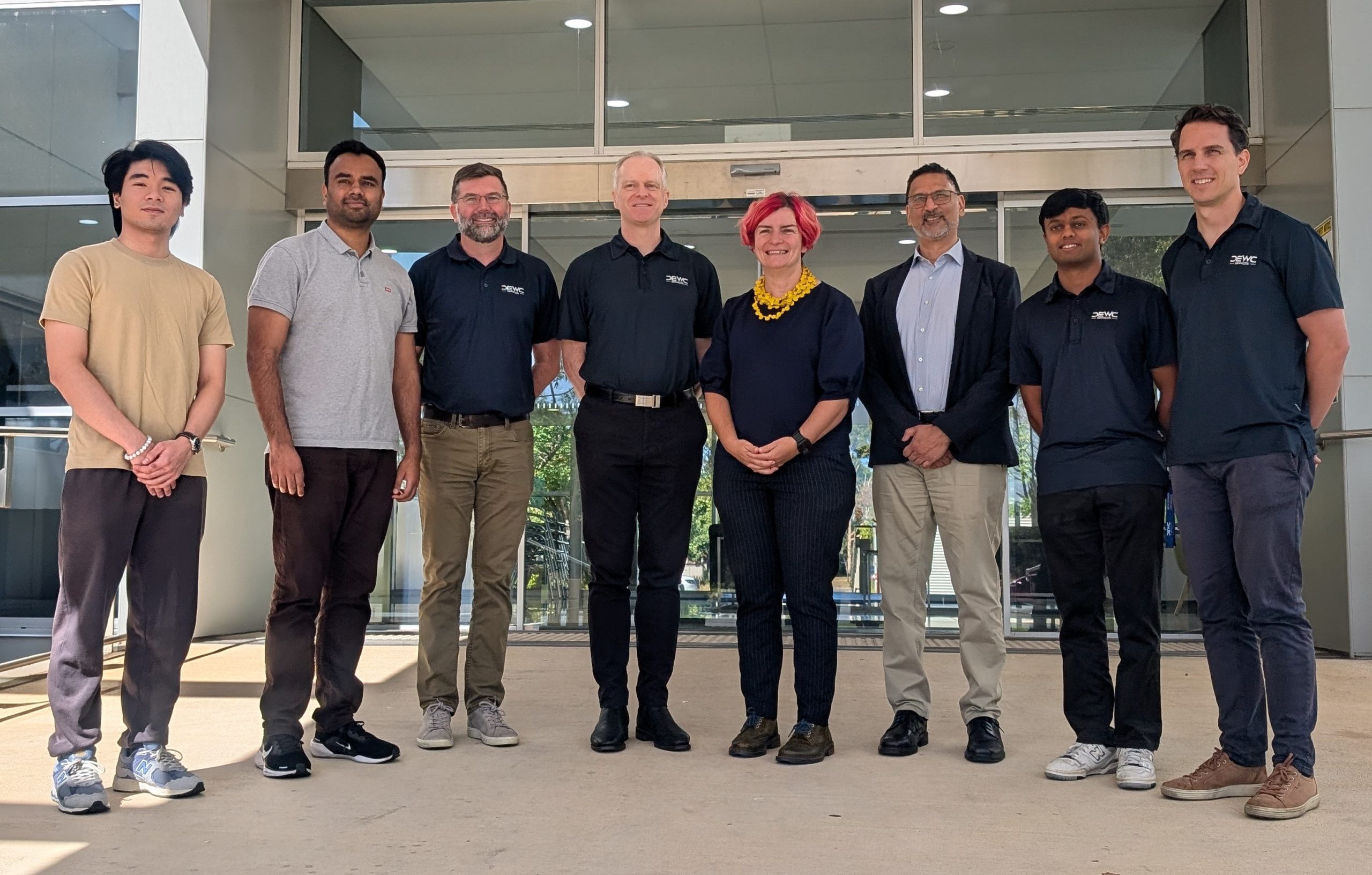
DEWC Services and Adelaide University researchers collaborate on AI-Enabled Decision Support Project. Photo and article courtesy of DEWC Services.
DEWC Services and Adelaide University have commenced a new research collaboration to advance sovereign AI-enabled decision-support capabilities for Australia’s Defence sector.
The project is translating advanced research in User Experience (UX), Artificial Intelligence and Machine Learning (AI/ML) into an operationally relevant open architecture capability designed to support faster and more effective decision-making in contested environments.
The research project is led by Adelaide University Professor Claudia Szabo with DEWC Services Product Manager, Anthony Kunda.
The program is supported by funding from Defence Trailblazer’s Technology Development & Acceleration portfolio, which focuses on translating priority research into deployable Defence capability.
Through its long-term partnership with Defence, DEWC Services has identified a recurring operational challenge for Defence users, who are often required to work across closed vendor-specific systems that do not interoperate effectively. This results in time-consuming manual workflows and places the burden of system integration on personnel rather than software.
“While these approaches may be workable today, they will not scale in high-tempo operations because they limit Defence’s ability to integrate new technologies at the pace demanded by the strategic environment,” said Mr Kunda. “Defence personnel should not have to act as the integration layer between disconnected systems.”
AI-enabled decision support that priorities interoperability
This research collaboration will develop an open vendor-agnostic software architecture to support semi-automated decision-support system, helping to reduce friction in Defence workflows. It builds on UX smart application and AI/ML concepts incubated by DEWC Services, the Defence Science and Technology Group (DSTG), and other research partners, including at Adelaide University.
“This project is about enabling open interoperable architectures so the right capabilities can be activated quickly when and where they are needed,” Mr Kunda said.
Professor Claudia Szabo said the project emphasises practical human-machine collaboration, stating: “The architecture will prioritise interoperability within Defence’s current network-centric environment, while supporting a transition toward data-centric operations.”
A key feature will be the use of natural language and other skill-agnostic user interfaces, enabling users to rapidly instantiate analysis and processing capabilities based on operational context.
“Better outcomes do not come from algorithms alone. They come from systems that are usable, trustworthy and aligned with how people work under pressure,” Professor Szabo said.
Developing architectures aligned with Defence priorities
Defence Trailblazer Executive Director, Dr Sanjay Mazumdar said the project reflects the program’s focus on translation and impact.
“This research is about moving beyond prototypes and developing architectures that can be tested, trusted and evolved within real Defence environments,” Dr Mazumdar said.
“This is the role of Defence Trailblazer. We exist to move ideas faster from concept to sovereign capability and this project is well aligned with that mission,” he said.
The collaboration is driven by Australia’s changing strategic environment. The 2024 National Defence Strategy highlights increasing strategic competition, alongside rapid technological change, compressed decision timelines, and growing grey-zone activity. Potential adversaries are investing heavily across multiple domains and accelerating their adoption of advanced technologies.
The project aligns with the National Defence Strategy, which identifies improved decision-making as one of the six core capability effects Defence must deliver. It also aligns with the Defence Data Strategy 2.0, which recognises data as a strategic asset that must be exploited more effectively across the enterprise.
As Defence continues to face increasing volumes of data from sensors and digital systems, the ability to process, analyse and disseminate information at speed will be critical. This collaboration represents a step towards delivering the tools and architectures needed to support timely, informed decision-making and operational success.