All
All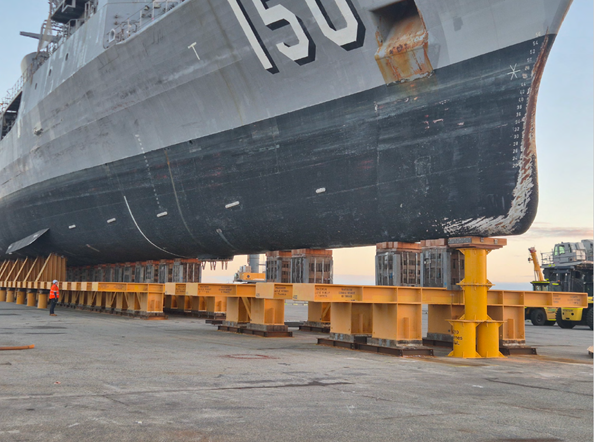
Nova Systems and RMIT collaborate on AI and Modelling & Simulation. Photo and article courtesy of Babcock Australasia.
When ex-warship HMAS Anzac was decommissioned in May 2024, she was docked on the Frigate Laydown Area (FLA) within the Australian Marine Complex’s Common User Facility (AMCCUF) — the only site in the precinct purpose-built to hold an Anzac Class frigate. But the FLA could not serve as her resting place for long. Other vessels required the space, and no alternative qualified hard stand existed at Henderson. The challenge was clear: how do you move a 3,500-tonne frigate to an uneven site safely and cost-effectively?
Two relocations were required — first to a temporary site for harvesting activities (recovery of serviceable parts), and then to a final location for disposal. Resurfacing was considered but ruled out due to cost and time. Instead, Babcock’s Naval Architect Team proposed an innovative alternative: sandboxes – a temporary, load‑bearing bed of compacted sand used to distribute weight evenly, stabilise loads, and protect underlying surfaces.
The method has been used before for smaller vessels but never applied to an Anzac Class frigate in Australia.
Move One: From the FLA to the temporary harvesting site
To enable the first move, civil engineers tested soil composition, surveyors mapped the site to millimetre precision, and the AMCCUF Dockmaster and Tutt Bryant Heavy Lift & Shift completed transit path calculations to confirm the Self‑Propelled Modular Transporter (SPMT) could safely lift and position the ship.
Once approved by the Director of Naval Engineering, 68 sandboxes were fabricated, installed, filled and compacted to create a level, engineered surface capable of supporting the ship’s cradles. This compensated for the uneven terrain and allowed the SPMT to move the frigate safely into position.
Move Two: From the harvesting site to the final disposal location
After harvesting, ex-HMAS Anzac moved to her final disposal site.
Within six weeks, the new site was surveyed and inspected, and another 68 sandboxes were fabricated and installed. Replacement cradle components — 16 concrete blocks, 144 supporting stools and 66 bracing components — were designed and manufactured locally, each built to a precise height to replace the cradle beams. The ship was repositioned and secured within five hours. A controlled collapse of the sandboxes transferred the load onto the supporting stools, allowing each cradle beam to be safely removed. This method enabled the complete recovery of the 400-series cradle set, preserving an important asset for future dockings.
Engineering excellence and collaboration
The dual-move operation was a feat of both engineering and collaboration. Babcock supply chain partner Allship Engineering led the cradle removal. Navy architects, Commonwealth stakeholders ANZACSPO and DG.Eng, and Babcock’s engineers worked side by side, ensuring every design met DEF(AUST) 5000 standards, including consideration of seismic and wind loads. On each moving day, the SPMT operators inched the frigate across the yard, aligning her precisely with the sandboxes.
What could have been a costly, drawn-out resurfacing project became a value-for-money solution — two-thirds cheaper, faster, and more versatile. The sandbox innovation opens the door to future naval and commercial ship dockings across parts of the AMC not previously used for this purpose, creating new operational capacity for Australia’s maritime future.
The project showcased Babcock’s ability to deliver smart, cost-effective engineering under pressure, supported by a highly skilled workforce — 74 per cent degree-qualified — and a Graduate Program that saw emerging engineers contribute directly to design, testing and stakeholder engagement. Together, the team – tasked under the Warship Asset Management Agreement – set a new benchmark in naval sustainment, achieved through innovation, precision, and strong collaboration across Defence and industry.
Babcock also drew on the strengths of its specialist supply chain, including Allship Engineering, Griffin Marine, IKAD Engineering, WGA, Linkforce, DC Survey and Tutt Bryant Heavy Lift & Shift.
“This project demonstrates the depth of our engineering capability and our commitment to empowering teams to innovate,” Babcock Australasia Managing Director Marine Simon Spratt said.
“Designing and implementing a sandbox solution for an Anzac Class frigate had never been attempted before. Working with millimetre tolerances, complex load calculations, and demanding conditions, our engineers delivered a fully assured design in just six weeks. Through close collaboration with SMEs and Defence stakeholders, we turned a highly technical challenge into a proven solution, which is a testament to the precision, resilience, and ingenuity that define Babcock’s engineering culture.”